
I know. Learning something new is challenging. Pono is no different. Let’s walk through how to set up your Pono.ai, step-by-step.
Here is a summary of the steps. The specific directions are below.
- Enroll using the code
- Complete the full Pono.ai setup
- Build your Brand Brain (don’t skip this)
- Enroll in PONO.AI Referral Program
Check out this video!
First things first… You need to enroll as a user in Pono. I know, I know, steps. But hang with me, this part actually matters. Once you’re set up, you’ll get your referral code. And that little code? Yeah… It’s kind of a big deal. You’re going to need it for your PBS pages, for your team, and for pretty much everything moving forward. So let’s get you set up first. Then scroll down, and I’ll show you exactly how to grab your referral code and actually use it.
Step One: ENROLL.
If you’re part of RRR247 or working with us as a business client, you’ve got access to a great deal. Use the promo code RRR247 and your price drops from $49.95 to $29.99 … and yes, that’s for life.
Let me just say this… people who skip the “launch and getting started” training? They miss a LOT. Don’t be that person.
Step Two: Set up Your Basic Information.
Once you’re in, you’ll have monthly credits to actually use the AI inside the Pono platform. You can work on your projects, build things out, and if you need more power, you can always add more credits as you go.
Now, before you run off and try to do everything at once, slow down for a second and follow the setup process below. This is where you build your Brand Brain, and trust me, that’s where things start to get really good.
After that, scroll down. You’ll see exactly where to enroll in the referral program so you can get your referral link. Look for: “Enroll in PONO.AI Referral Program” right below the setup section.
Once you’re set up, you’ll be walked through creating your “Brand Brain.” Now, don’t let the name intimidate you. This is actually the fun part. This is where Pono starts to learn you, your business, and how you want things done. Think of it like building the engine that’s going to power everything moving forward.
If you’re a RRR247 member, you’re going to see a specific set of questions. I’ll show you exactly how to answer those below. And yes, you can absolutely tweak things, add to it, and make it your own. This is your Brand Brain, your business, and you are in charge.
So don’t overthink it… But don’t rush it either. This part matters.
That’s where I walk you through it step-by-step so you’re not guessing.
Step Three: Brand Brain
PONO Brand Brain Onboarding: Before You Begin
Before you dive into the actual questions, let me save you some frustration… these tips will make a huge difference in how well this works for you:
- Take your time. Rushing leads to shallow answers, and shallow answers lead to weaker AI outputs.
- Be specific, not generic. If you give vague answers, you’ll get vague results. The more detail you give, the more the AI actually sounds like you and becomes useful.
- Answer in complete thoughts. One-word answers usually don’t give the AI enough to work with.
- Speak in your natural voice. The AI captures how you communicate, so don’t try to sound overly polished or corporate. Be in a quiet area, and be sure to speak clearly and slowly (so it can keep up).
- Have supporting materials ready. Logo file, website link, and any key numbers (revenue, funding, team) within reach. For Revenue and Funding, you can say “I do not want to Answer That Now”
- Use real numbers when you can. Revenue, customers, team size, and funding: real numbers train the AI way better than guesses.
- Have key numbers ready. Revenue, team count, funding figures: pull them up before you start so you’re not guessing.
- Don’t skip questions. Every single one feeds your Brand Brain. Skip pieces, and you weaken the whole thing.
- If you don’t know something, just say so. It’s better to be honest than to make something up and confuse the system later.
Trust me! Doing it this way will save you time and give you much better results.
PONO Brand Brain Onboarding: The Questions
Before you begin, know your stuff. The actual questions may be different. As Pono is being updated and learning, questions may be asked in a different way or in a different order. Don’t let it shock you. Be prepared.
After we give you the generic tips, we will give you specific tips for anyone who is in the RRR247 community.
Business Basics
1. What is the name of your business?
- Write it exactly how you want it branded (capitalization, spacing, and punctuation all matter)
- If you have both a legal name and a brand name, include both. For example:
- Twin Designs Tech LLC
- Twin Designs
- This is your brand, so make sure it looks right.
2. What industry are you in?
- Be specific. “Consulting” is too broad.
- Say what you actually do and who you do it for. For example:
- Growth consulting for B2B SaaS founders
- If you sit between categories, say that. It helps define what makes you different.
3. What year was your business founded?
- Give the actual founding year, even if you’ve rebranded or pivoted since.
- If there’s a difference between when you started and when you officially incorporated, include both.
4. What is the legal structure of your business?
- Examples: Sole Proprietorship, LLC, S-Corp, C-Corp, Partnership, Nonprofit.
- If you’re pre-formation or operating informally, say so.
5. Where is your business located?
- Include city, state/province, and country.
- If you’re fully remote or operate in multiple locations, mention that too.
6. What is your current website?
- Share the exact URL.
- If you don’t have one yet or you’re in the middle of a redesign, just say that.
Business Overview
7. Can you give a brief overview of your business?
- Start with who you help, then the outcome you create. For example:
- “We help consulting agency owners double their capacity without hiring, by giving them an AI Chief of Staff that delivers in their voice.”
- Keep it to 2-4 sentences. Enough to capture what you do without rambling.
8. How does your business differentiate itself from competitors?
- If you’re comfortable, name specific competitors and explain what you do differently.
- Skip the “we’re the best” stuff. Focus on what you can actually show: your method, pricing, speed, niche, or anything unique you bring to the table.
9. Who are your key partners or collaborators?
- List strategic partners, referral sources, technology integrations, or vendors.
- Include the people or tools that are essential to how you deliver: not just casual connections.
10. What is your business model?
- Options include: B2B, B2C, B2B2C, D2C, marketplace, platform, SaaS, subscription, service-based, etc.
- If you use more than one, just tell us which one is primary.
11. What are your primary revenue streams?
- Break it down by source: services, products, subscriptions, licensing, ads, affiliate, etc.
- If you know the split, include rough percentages (for example: 70% services, 30% digital products).
12. What are your main products or services?
- List them clearly, one at a time. Don’t just say “we do everything.” For example:
- Service or product #1
- Service or product #2
- Service or product #3
- Also, note which one is your main or flagship offer.
Financials & Scale
13. How much working capital do you have?
- Give a rough figure or range: this is the cash you have available to operate.
- If you’re self-funded, pre-revenue, or post-raise, include that context.
14. What is your average monthly revenue?
- Use real numbers. Monthly averages work better than annual or quarterly.
- If revenue is highly variable, share both your low and high months.
15. About how many customers or clients do you serve?
- Share your current active count, not lifetime total.
- If you distinguish between active vs. inactive customers, clarify.
16. How many team members do you have?
- Include full-time, part-time, and contractors.
- If it helps, break it down. For example:
- 3 full-time
- 5 contractors
- 2 part-time VAs
Founder & History
17. What is your background and experience before starting this business?
- Share relevant career history, industry experience, or expertise.
- Focus on what connects to what you’re building now, not your entire life story.
18. What inspired the founder to start this business?
- Tell it like a story. What were you doing before? What made you start this?
- This is your “why,” and it becomes part of your brand voice and origin story.
19. What were the major milestones in your business journey?
- List 3–5 key moments. For example:
- First client
- First hire
- Product launch
- Major pivot
- Revenue milestone
- Include dates or rough timeframes if you can.
Goals & Challenges
20. What are your 6-month business goals?
- Be specific. Use numbers where you can (revenue, clients, launches, team growth).
- Prioritize your top 2–3 goals, not everything.
21. What are your 12-month business goals?
- Paint a bigger picture than the 6-month view. Where do you want the business to be in a year?
- Include both business metrics and what your life looks like when you hit this.
22. What is the biggest challenge you’re currently facing in your business?
- Be honest. Is it capacity, marketing, sales, operations, your time, funding, or mindset?
- Name the real one, not the “nice” answer.
23. Is there anything else you’d like to add to your Brand Brain?
- This is your space to include anything important we didn’t cover.
- If there’s something the AI should know, say it here.
Exit Strategy
24. Have you planned your business exit strategy?
- Answer yes or no, and share how formalized the plan is.
- If you haven’t thought about it yet, that’s okay, just say so.
25. What’s your perfect exit plan?
- Options include: acquisition, IPO, management buyout, family succession, lifestyle business (no exit), or wind-down.
- Include a timeline and target valuation if you have one in mind.
27. Core Values
- List 3–7 values that guide your decisions.
- For each one, add a short explanation of what it actually looks like in practice—not just the word.
- For example:
- Radical transparency: we share numbers, mistakes, and trade-offs openly
- Keep it real and meaningful.
Funding
28. Are you currently looking for funding for your business?
- Simple yes or no.
- If yes, share what stage you’re at. If you’re not actively looking but open to the right opportunity, just say that.
29. Have you explored any funding options so far?
- List what you’ve considered or pursued: bootstrapping, friends & family, angels, VC, revenue-based financing, grants, crowdfunding, loans.
- Include where you are with each one.
30. What are you looking for funding for?
- Be specific about how you’ll use the funds: hiring, product development, marketing, inventory, expansion, or runway.
- Prioritize your top 2–3 uses, not everything.
31. How much funding are you looking for?
- Share your target amount or a range.
- If you’re open to different deal sizes or structures, mention that.
Final Finishing Step For Onboarding
Before you wrap this up, take a minute and do it right. Your future will thank you.
Review before finalizing. When you get the chance to review, use it. You never know what pono actually got. Don’t just click through as we all do (and pretend that we don’t.).
Don’t forget, you can always go back and edit your Brand Brain as you get more details or your business changes!
PONO RRR247 Brand Brain Onboarding: Before You Start
Before diving into the questions, keep these in mind throughout the entire onboarding process:
- Take your time. Rushing leads to shallow answers, and shallow answers lead to weaker AI outputs.
- Answer in complete thoughts. One-word answers usually don’t give the AI enough to work with.
- Speak in your natural voice. The AI captures how you communicate, so don’t try to sound overly polished or corporate. So be in a quiet area, and be sure to speak clearly and slowly (so it can keep up).
- Be specific, not generic. Vague answers produce vague AI outputs. Concrete details produce on-brand, useful results.
- Have supporting materials ready. Logo file, website link, and any key numbers (revenue, funding, team) within reach. For Revenue and Funding, you can say “I do not want to Answer That Now”.
- Have key numbers ready. Revenue, team count, funding figures: pull them up before you start so you’re not guessing.
- Use real numbers when possible. Revenue, customer counts, team size, and funding amounts. Actual figures train the AI better than estimates.
- Don’t skip questions. Each one feeds directly into your Brand Brain. Incomplete answers lead to weaker AI outputs.
- If you don’t know an answer, say so honestly. Better to acknowledge a gap than to fabricate information. Say something like “I do not know that Answer Right Now”.
PONO RRR247 Brand Brain Onboarding: The Questions
Business Basics
1. What is the name of your business? Most Students, especially New Students are operating as a Sole Proprietor. So you will use your Full Name. I.E. Rory Ricord.
- Say it exactly how you want it branded — capitalization, spacing, and punctuation all matter.
- If you have a legal name and a brand name, share both (e.g., “Twin Designs Tech LLC, but we go by Twin Designs”). Make Sure your Spelling is Correct.
2. In which industry does your business operate?
- Be specific. “Consulting” is too broad. “Growth consulting for B2B SaaS founders” is better.
- If you sit between categories, say so: it helps define your unique positioning. We are in the Online Marketing Industry. We utilize Performance Blogging for Content, Imagery and Videos to Educate, Instruct, and Market Products and Services to the Online Population.
3. What year was your business founded?
- Give the actual founding year, even if you’ve rebranded or pivoted since.
- If there’s a distinction between when you started versus when you formally incorporated, note that. State the Starting Point when you Began RRR247, or your Business, whatever you are starting with. Do not overthink it.
4. What is the legal structure of your business?
- Examples: Sole Proprietorship, LLC, S-Corp, C-Corp, Partnership, Nonprofit. Most RRR247 Students are Sole Proprietors, so “Sole Proprietership”. If you have and operate as an LLC or a corporation, then State that accordingly.
- If you’re pre-formation or operating informally, say so.
5. Where is your business located?
- Include city, state/province, and country.
- If you’re fully remote or operate in multiple markets, mention that too. RRR247 Students are Online. We can be Based in a City/State. So Mention you are Based in “City/State” but are Working Globally to Market Around the World.
6. What is your current website?
- Share the exact URL. Example 1f16.com (One-F as in Frank-One-Six-dot-com)
- If you don’t have a website yet, or you’re in the middle of a redesign, mention that.
Business Overview
7. Can you give a brief overview of your business?
- Start with who you help, then what outcome you create. Example: “We help consulting agency owners double their capacity without hiring, by giving them an AI Chief of Staff that ships deliverables in their voice.”
- Aim for 2-4 sentences. Enough to capture the essence without rambling.
For RRR247: “We are an Online Marketing System using our Website to Share Product and Services by Category. We use Advertising in Free Classifies, Social Media, YouTube and Videos and Blogging Pages in our Website to Share the Marketing Message of the Products and Services we Represent to share and Gain Customers”
8. How does your business differentiate itself from competitors?
- Name specific competitors if you’re comfortable, and explain what you do differently.
- Avoid “we’re the best” framing. Focus on what’s measurable or provable.
- Think about: your methodology, pricing model, speed, niche focus, or unique IP.
For RRR247: We are working together with our RRR247 Team to Build and Leverage Shared Compensation for the Customers We Gain from the Marketing. So we are working in teams to market by Consensus. Using our individual Websites to Market, building a shared Customer Base. So we get to leverage the work and progress of our Teams in addition to our Own Work. We focus on Health and Wellness Niche’s in the Anti-Aging, Lifestyle and Quality of Life. We have Weightloss that Works, and Cellular Nutrition for the betterment of our Bodies. We focus on Services and Training for Businesses and New Business Start-Ups and Established Businesses alike. We focus on Services that Help Families Save Money on Everyday Needs and Eating and Dining Out. Along with Savings in Travel, and Lifestyle needs. As well as Pets and Their Needs, Free Stuff that we can Share Online and ongoing Additions as Hot New Things are Brought into our RRR247 Teams.
9. Who are your key partners or collaborators?
- List strategic partners, referral sources, technology integrations, or vendors.
- Include anyone who’s essential to how you deliver — not just casual networking contacts.
FOR RRR247: This is usually you and your TEAM. However for starting out, you can say “No one at this Time”.
10. What is your business model (B2B, B2C, etc.)?
- Options: B2B, B2C, B2B2C, D2C, marketplace, platform, SaaS, subscription, service-based, etc.
- If you operate in more than one model, say which is primary.
FOR RRR247: We focus on B to C primarily. Though offer B to B Services as well. So both B to B and B
11. What are your primary revenue streams?
- Break it down by source: services, products, subscriptions, licensing, ads, affiliate, etc.
- Include rough percentages if you know them (“70% services, 30% digital products”).
FOR RRR247: We have Anchor Offers. Velovita is our Health and Wellness Program and Represents 50% of our Income. Then our Anchor Offers in our PBS Vortex Services Represent 35% of our Income. Then our Anchor Offer FunSaverNetwork represents 15%. All of our focus is in these 3 Anchor Offers and Primary Areas of Focus are the Primary Revenue Sources.
12. What are your main products or services?
- List them clearly, one at a time. Don’t just say “we do everything.”
- Note which is your flagship or primary offer.
FOR RRR247: For breaking it down from the 3 Anchors. We have Velovita which we focus on Brain which is a Nootropic, Reserve which is a Heart Health Product, Luminesce for High End Luxury Skin Care and Anti-Aging Skin Results, (m)mun (Immune) that is a Powder for Probiotics and Gut Health, AM Essentials for Cellular Wellness to Awaken the Day, and PM Essentials for Sleep and Evening Cellular Wellness to arm us for the Restoration of our Sleep, Finiti for our Telemeres and Anti-Aging Process, RevitaBlue for the Blue Green Algae Superfood, Mind (M-1-N-D) for Brain Function and Clarity, LIFE NMN for NAD+ creation and more, M-MUN 365 for Immune Support, and Tuun (tune) for EMF Protection.
Then For PBS Vortex we have the PBS Vortex Service itself for our Team Members we add into our RRR247 Business as Parters with us. Our tools and then specific programs like Brainfood Academy our online Learning Course Business, Pono.Ai our AI Tools Business, Online Charity Auctions, and more as added. Things are always coming our way so we are adding them as they prove they work in our Performance Blogging Business Model.
For FunSaverNetwork we are dealing with a Free or Member Fee Savings Program. Offering savings on dining, travel, eating out as well as Deals that Drop at 7pm EST Monday to Friday where Items that are $30 to $300 are avaialble first come first serve for $5, $8 or $12. Where we have Special Drops and Discounts and Mystery Boxes to Market.
Then in additon we have Revenue Sharing with Google AdSense for Ads running on our PBS, my Website Domain again is (state it). And looking to earn from the Web Traffic generated into the Website.
Financials & Scale
13. How much working capital do you have?
- Give a rough figure or range. This is the cash you have available to operate.
- If you’re self-funded, pre-revenue, or post-raise, mention that context.
FOR RRR247: We have a low overhead to maintain our Full Business. So our Capital Requirements are a couple hundred dollars a day. We have paid marketing, funded by Rory and Tanya Ricord with RRR247 so our Marketing Budgets are Paid for us by the System. We really have the Capital of our TIME to apply to the RRR247 System to Focus On.
14. What is your average monthly revenue?
- Use real numbers. Monthly averages work better than annual or quarterly.
- If revenue is highly variable, share both your low and high months.
FOR RRR247: I have been getting this set up and going. So the revenues are out from getting things into place. We have had a high month of $_____ and a low month of $______.
or adjust as your time in has been here and your HIGHEST / LOWEST AMOUNTS with your ongoing Trend of the past YEAR. If you have been here for years, focus on your latest 6 months to a year.
15. About how many customers or clients do you serve?
- Share your current active count, not lifetime total.
- If you distinguish between active vs. inactive customers, clarify.
FOR RRR247: With regards to Velovita, I have ___ Customers and ___ Members to build with. For PBS Vortex I have added ____ Instructors or Customers and the Team has added ____. For FunSaverNetwork I have added ___ Paying Members and ____ Free Members.
Approximations are OK. Though try to be as accurate as you can.
16. How many team members do you have?
- Include full-time, part-time, and contractors.
- Break it down if helpful (e.g., “3 full-time, 5 contractors, 2 part-time VAs”).
FOR RRR247: In my direct Team that is Under Me as an Instructor with RRR247 I have ____ Direct Members and an Extended Team of ____ including my Instructor Team and Support Members in Total.
Founder & History
17. What is your background and experience before starting this business?
- Share relevant career history, industry experience, or expertise.
- Focus on what’s relevant to what you’re building now.
FOR RRR247: You want to have this ready, and go into all things you are about. This will be helpful, and no-one else is you. So State You in This.
18. What inspired the founder to start this business?
- Tell it like a story. What were you doing before? What made you start this?
- The personal “why” becomes part of your brand voice and origin story.
FOR RRR247: Start why you are doing this, what is your WHY and why you chose to do it with your RRR247 Business. Details, and state the WHY’s. ALL of them.
19. What were the major milestones in your business journey?
- List 3-5 key moments: first client, first hire, product launch, major pivot, funding round, revenue milestones.
- Include dates or rough timeframes when possible.
FOR RRR247: Include Completing your Performance Blogging System to have Google AdSense Approved and Running. To then getting your Google AdSense going. When you got your first PBS Student Added to your Team.
IF STARTING: Working on the Milestones to have my PBS Website (state it again) Ready to get Google AdSense Approved and Activated. To get my Team Building with the use of the PBS Vortex and the Paid for Me Marketing. And to build my Velovita Customers and FunSaverNetwork Customers.
Goals & Challenges
20. What are your 6-month business goals?
- Be specific with numbers: revenue targets, client count, launch milestones, team additions.
- Prioritize — name the top 2-3 goals, not every possible goal.
FOR RRR247: To get my Initial 10 Team Members added using the PBS Vortex. To then progress in the Marketing and Growth Actitivies to build the Income from my RRR247 Income Streams to be $____ a week.
If Established CSI or ABOVE, then alter for your Goals!
21. What are your 12-month business goals?
- Paint a bigger picture than the 6-month view. Where do you want the business to be in a year?
- Include both business metrics and what your life looks like when you hit this.
FOR RRR247: To get my Initial 50 Team Members added using the PBS Vortex. To then progress in the Marketing and Growth Actitivies to build the Income from my RRR247 Income Streams to be $____ a week.
If Established CSI or ABOVE, then alter for your Goals!
22. What is the biggest challenge you’re currently facing in your business?
- Be honest. Is it capacity, marketing, sales, operations, your own time, funding, or mindset?
- Name the real one, not the socially acceptable one.
FOR RRR247: How to structure my days to get my PBS (State Website URL) Completed for Google AdSense and Creating Information Pages that will gain Traction with Google Search and that can be Viral online.
23. Is there anything else you’d like to add to your Brand Brain?
- This is your chance to add context that didn’t fit elsewhere.
- Consider: unique history, controversies, upcoming decisions, seasonal patterns, anything the AI should know.
FOR RRR247:
Be Sure to Add As Much as You Can. You can edit and add more later. But the more you begin with the better.
Exit Strategy
24. Have you planned your business exit strategy?
- Answer yes or no, and share how formalized the plan is.
- If you haven’t thought about it yet, that’s okay — just say so.
FOR RRR247: This is being built to be able to pass down to my Family when I am no longer here.
25. What’s your perfect exit plan?
- Options: acquisition, IPO, management buyout, family succession, lifestyle business (no exit), or wind-down.
- Include a target timeline and valuation if you have one in mind.
FOR RRR247: This is a Lifestyle Business and LEGACY for my Family when I am no Longer Here.
26. Core Values
- List 3-7 core values that guide your business decisions.
- For each value, add a short description of what it means in practice — not just the word.
- Examples: “Radical transparency — we share numbers, mistakes, and trade-offs openly with clients.”
For RRR247: We have our Core Values for RRR247: https://rrr247.com/basic below. You can use these, or/and add your own:
We Love Everyone
We operate for success with set Protocols in Training for our Students. We utilize time management to teach, inspire and support the successes of our Students. Always.
We Are A Family
We help each other. Always. Each Instructor is expected to guide and help any and all Students.
Strive For Awesome-Ness
In everything we do, in every way. Always.
Add in what you want!
Funding
27. Are you currently looking for funding for your business?
- Simple yes or no. If yes, share the stage you’re at.
- If you’re not looking but open to the right opportunity, say that.
FOR RRR247: No, not at this time.
28. Have you explored any funding options so far?
- List what you’ve considered or pursued: bootstrapping, friends & family, angels, VC, revenue-based financing, grants, crowdfunding, loans.
- Include where you are in the process with any of them.
FOR RRR247: No, not at this time.
29. What are you looking for funding for?
- Be specific about use of funds: hiring, product development, marketing, inventory, expansion, runway.
- Prioritize — name the top 2-3 allocations.
FOR RRR247: No, not at this time.
30. How much funding are you looking for?
- Share the target amount or range.
- If you’re open to different round sizes or structures, mention that.
FOR RRR247: No, not at this time.
Final Tip Before You Finish Onboarding
Before you wrap this up, take a minute and do it right. Your future will thank you.
Review before finalizing. When you get the chance to review, use it. You never know what pono actually got and understood. Don’t just click through as we all do (and pretend that we don’t.).
Don’t forget, you can always go back and edit your Brand Brain as you get more details or your business changes!
Step Four: Enroll in PONO.AI Referral Program.
Once you have a Pono.AI Account. You can get activated in the Referral Program.
- Log Into your Pono.ai Account
- Go into your Settings (Bottom Left Corner)
- Then look for Affiliate Link (Below Phone Number)
Then you want to LOG INTO Your REFERRAL ACCESS (You’ll have this once you Enroll In the Referral Program) Called FirstPromoter. Set up your Payment, To PayPal. (You know how we love PayPal!) And get your Referral Link.
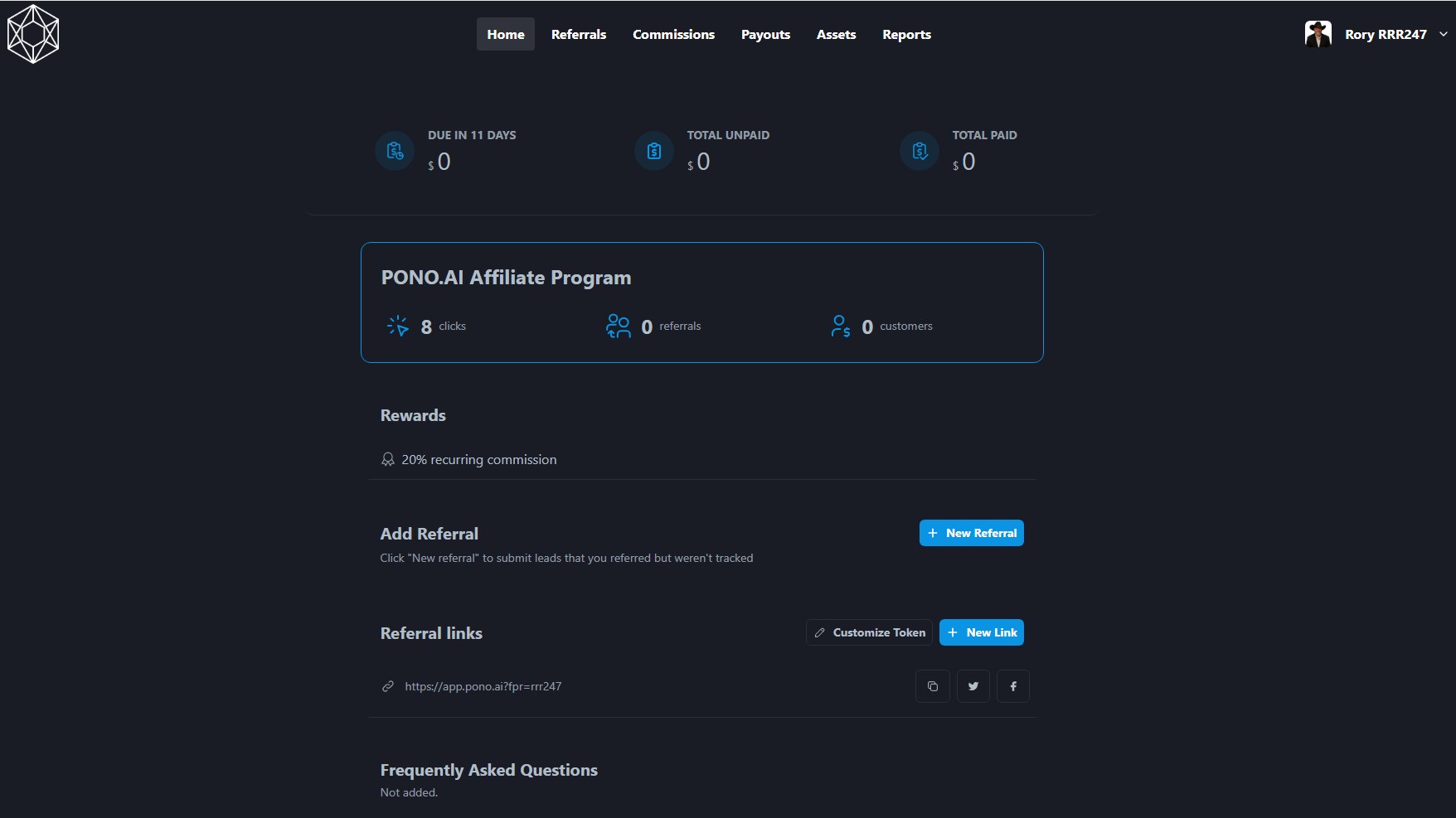
NOTE: You can alter the code to be anything you want, but once you use it, you do not want to change it.
Other Reference Points:
FACEBOOK GROUP FOR PONO.AI: https://www.facebook.com/groups/ponoai
AND we will be covering things for RRR247 for more in our Tuesday and Saturday Training. This is an ONGOING Addition to Our Offerings.